

GoALS is a large-scale scientific programme designed to achieve a breakthrough in the treatment of ALS. It is a multi-year effort that involves significant scientific work and substantial funding.
GoALS: an ambitious master plan
To accelerate a breakthrough in ALS treatment, the Dutch ALS Patients’ Association, the ALS Foundation Netherlands, and the ALS Centre Netherlands (UMC Utrecht) have joined forces. Together, they developed GoALS: an ambitious master plan and multi-year research programme involving more than 120 researchers, entirely focused on speeding up the development of therapies for ALS, PLS, and PMA. 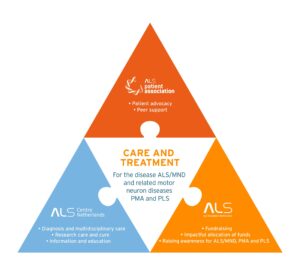
GoALS uses an integrated approach that is unique in scale. Thanks to GoALS, three major research groups at the ALS Centre Netherlands can carry out their plans together, working toward one shared goal: a breakthrough in the cure for ALS. Together, these research groups form a platform for developing new treatments, spanning everything from discovering new ALS-specific gene mutations, to ALS patient models grown from human cells, to clinical trials. All research takes place under one roof.
For GoALS, the funding structure has been redesigned so researchers can build on promising results faster and collaborate across disciplines more easily. Instead of applying for individual research grants, GoALS enables the execution of one large, long-term plan. This also allows research funding to be deployed far more flexibly, directed to wherever it is needed most urgently. In addition, GoALS partners with pharmaceutical and biotech companies through co-financing and strategic collaborations, helping the most promising ALS treatments move from research to clinical practice as efficiently as possible.
GoALS is unique in ALS research worldwide, standing out in three key ways:
- Greater coherence. Because researchers across different research lines plan together and are jointly accountable for their work within GoALS, the various studies are more closely connected and collaboration is stronger.
- Greater continuity. A continuous stream of funding makes it possible to retain staff over longer periods and ensure essential research can continue.
- Greater effectiveness. Faster, improved collaboration with the pharmaceutical industry means research findings can reach people with ALS, PMA, and PLS as therapies more quickly.
A breakthrough in research can never be guaranteed. Still, we are convinced that the structured approach of the GoALS programme will make major breakthroughs happen faster than they otherwise would , ultimately benefiting everyone affected by ALS, PMA, and PLS.
The people behind GoALS
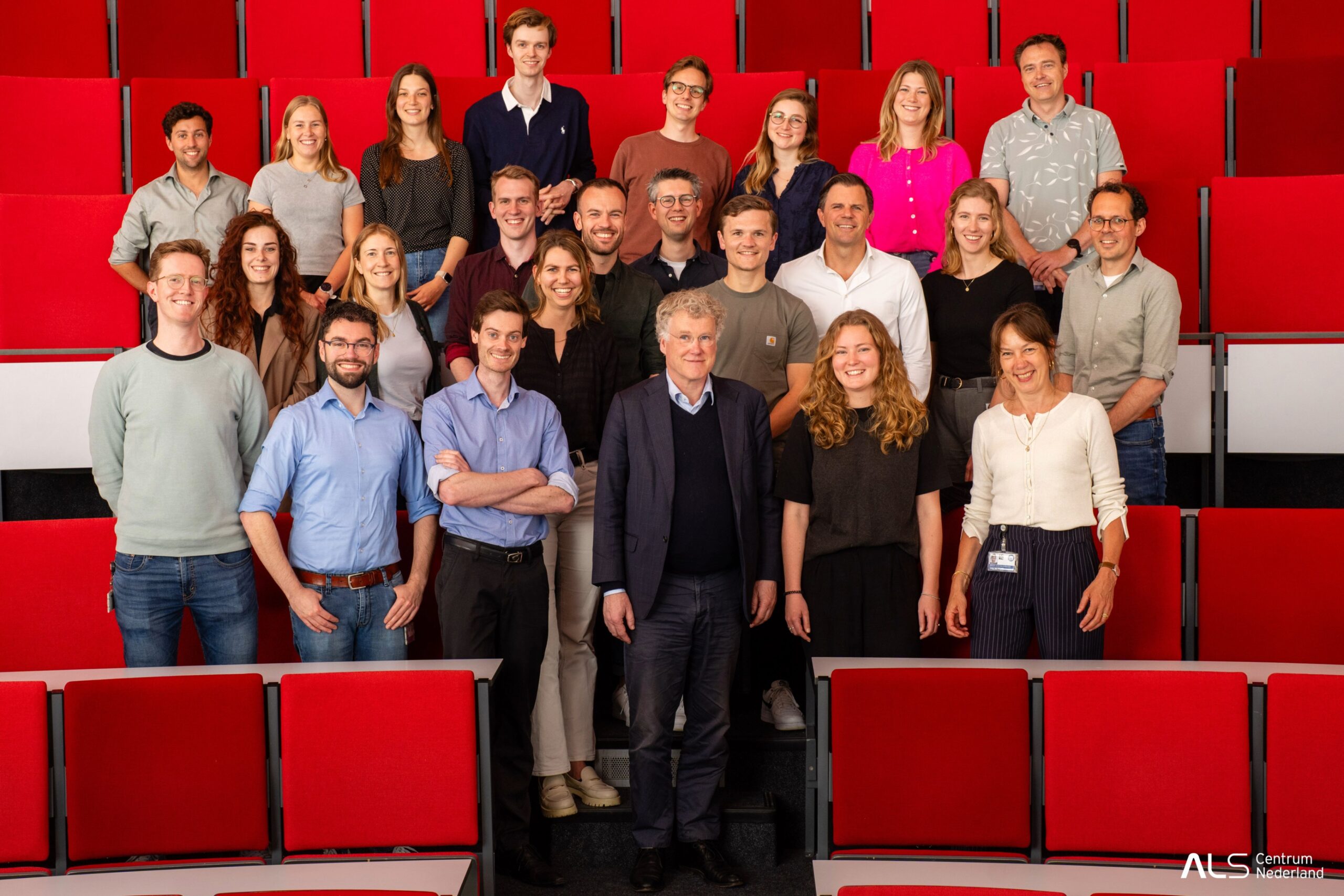
Meet the people behind GoALS:



Research pillars
Much of the research conducted at the ALS Centre Netherlands falls under GoALS. Within GoALS, researchers from different backgrounds — genetics, diseasemodels, and clinical research — can collaborate far more closely, accelerating the path to a research breakthrough. The biobank and database underpin all three research pillars. All research takes place under one roof, at the ALS Centre Netherlands, based at UMC Utrecht.
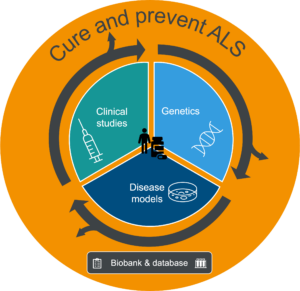
The GoALS programme consists of three research pillars plus the biobank.
-
Genetics
Improving the discovery phase – As more gene-targeted therapies emerge, understanding the genetic basis of ALS is more important than ever, allowing people with ALS and their family members to be treated and counselled individually based on their own genetic risk. Currently, only 15% of the genetic basis of ALS is known, meaning there is still a great deal of genetic information left to uncover.
-
Disease models
Improving the pre-clinical phase – A defining challenge in drug trials is that many studies show no effect and ultimately fail, sometimes only becoming clear in the final stage of drug development, during large-scale Phase 3 trials. ALS is no exception. To address this, new experimental models are needed that use patient cells in the laboratory. These models make it possible to study, for individual patients or small patient groups, how ALS develops and which medications might be effective. This acts as a form of pre-screening, reducing the number of people exposed to trials of ultimately ineffective drugs.
-
Clinical studies
Improving the clinical phase – A central goal of this research pillar is testing potential new medicines in clinical trials involving people with ALS. This also includes documenting how ALS, PMA, and PLS present across large groups of people, recorded in the National ALS Database (since 2006). This involves tracking a broad range of disease characteristics (rate of progression, age, family history, weight, etc.), lifestyle factors (exercise, diet, etc.), and exposure to environmental factors (occupation, pesticides, etc.). To generate results as accurately and quickly as possible, it is essential to use the best and most advanced research methods and to capture as complete a picture as possible of how the disease progresses (including neurophysiologyand imaging techniques).
-
Biobank en database
The foundation beneath all three research pillars is the collection of medical data, biological samples, and study measurements from large groups of people with ALS, PMA, PLS, control participants, and family members. The Biobank & Database team is a dedicated group of research staff who handle administration, logistics, measurements, and testing for the biobank and observational studies. This team makes the first contact about participating in research, and is present at the clinic on the day of diagnosis to answer patients‘ questions about joining the NMD Biobank. Consent and contact details are recorded in a database, forming the basis for collecting further data over time. Trust and care are essential here, supporting patients‘ continued participation in research throughout their illness.

The GoALS team on the GoALS Progress Meeting (May 2 2025, Zeist).